Research
Job Market Paper
Presented at: EUI Alumni Conference (2025), EUI Macro Group (2026), EUI Microeconometrics Group (2026), Midwest Macro Winter Meeting (2026), ECB DG Research (2026)
Paper (PDF) | Online Appendix (PDF) | Slides (PDF)
Abstract
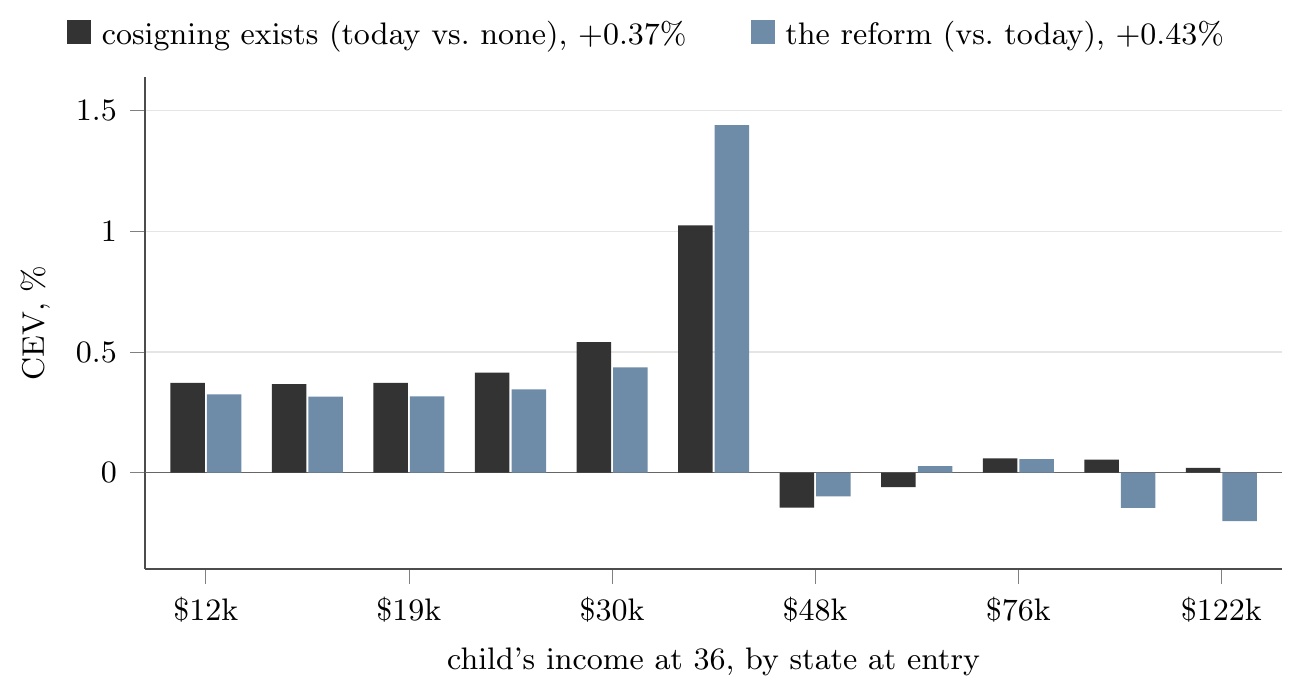
Parents can make a child's mortgage safer by cosigning, making credit more accessible and affordable. Unlike a commercial guarantor, who would only select on safety, the parent also cares about the child's gain, introducing adverse selection. Building a novel dataset from web-scraped deeds and administrative data, I construct the first U.S. measure of parental cosigning. I provide evidence that, under current U.S. market practice, underwriting acknowledges cosigning only partially on admission but not for pricing—banks charge the same rate to solo and cosigned borrowers. Using this evidence, I estimate a general-equilibrium model with asymmetric information, and show that cosigning in the U.S. delivers less than it could: (a) cosigning families overpay by 25 basis points, and still, cosigning raises ownership rates by 0.8 percentage points; (b) a counterfactual scenario suggests that if prices adjusted for both cosigning status and parental income, the guarantee could increase access to homeownership by an additional 0.6 percentage points without increasing defaults.
Publications
Does Political Violence Undermine Descriptive Representation? The Case of Women in Politics
- European Journal of Political Research
joint work with
Jeyhun Alizade,
Fabio Ellger and
Thomas Tichelbaecker
Abstract
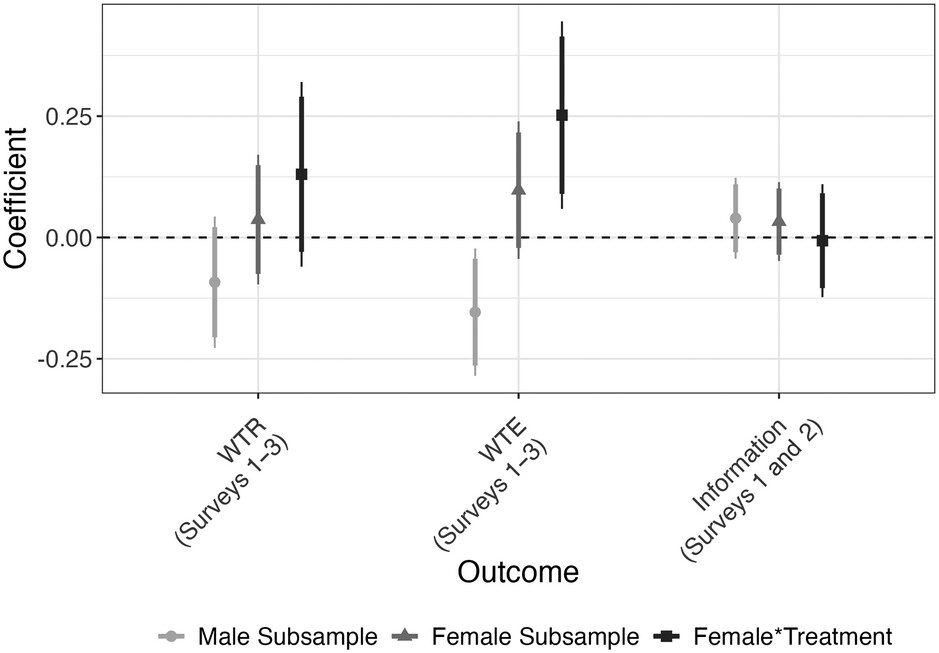
Do attacks against politicians exacerbate the political underrepresentation of marginalized groups? Existing research suggests that candidates and office holders from underrepresented groups are more likely to become targets of political violence, but little is known about the consequences of indirect exposure to political violence for descriptive representation and political ambition. Focusing on the case of women in politics, we study how the prevalence of political violence affects both the descriptive representation and the political ambition of women in Germany – Europe’s largest democracy. Combining an analysis of observational data measuring crimes against politicians with evidence from original and pre-registered survey experiments, we first demonstrate that attacks on political elites are not associated with fewer female candidates on party lists for local elections. Examining political ambitions and underlying microfoundations with different samples of respondents varying in their likelihood of considering political candidacy, we provide survey‐ experimental evidence that information about the prevalence of political crime does not reduce willingness to run for office or engage in politics among female respondents with high political interest, but may do so among those with low political interest. Taken together, this study highlights resilience of underrepresented groups in face of increasing political violence. However, we also show that political violence may create a pipeline problem if it deters the wider population of women from even considering to run for office.
Working Papers
with Alberto Ferreira and David McCarthy
Presented at: ECB Early Ideas Seminar (2024), CREI Macro WG (2025), EUI Macro Group (2026)
Abstract
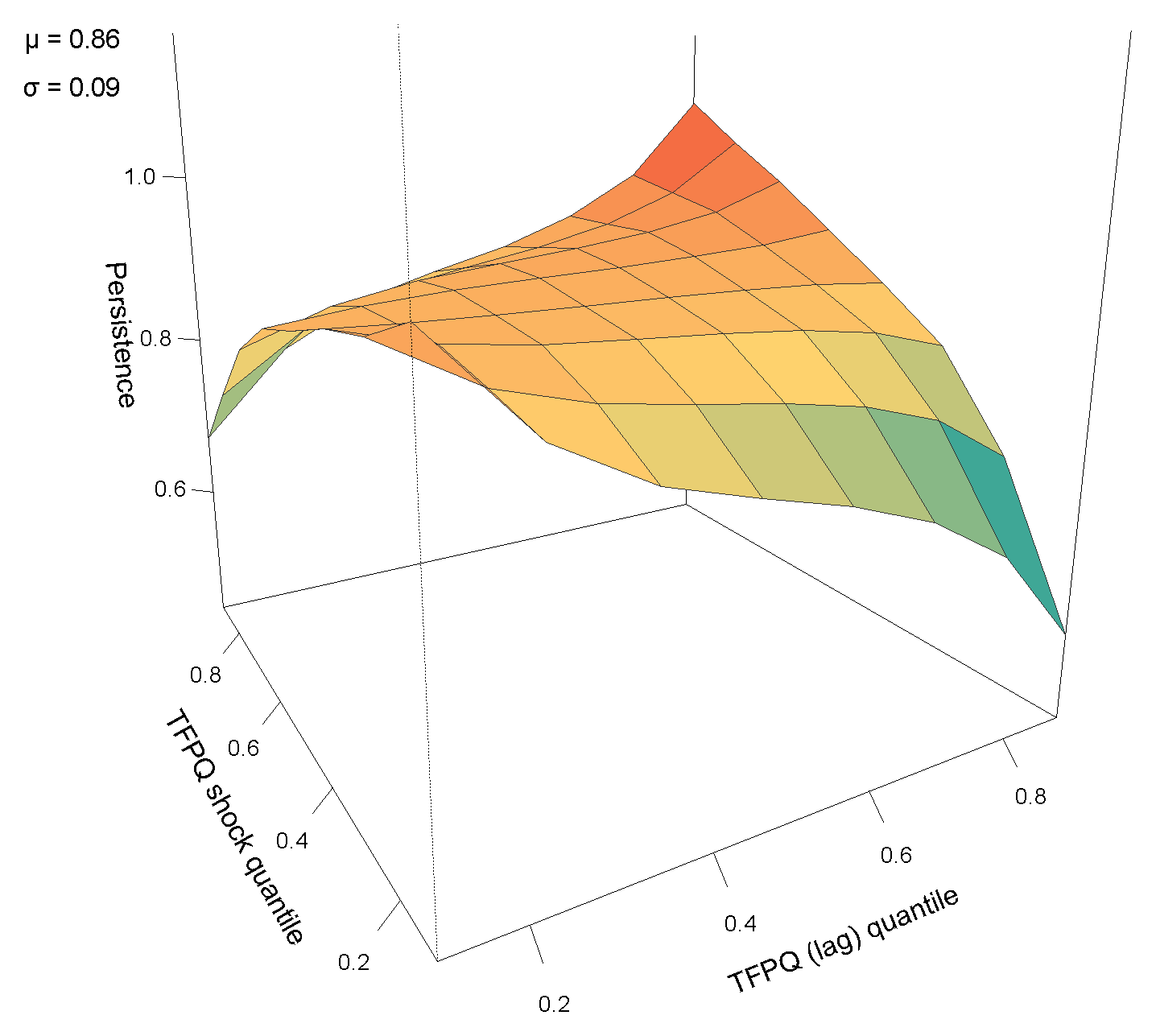
Models of price setting and firm dynamics almost always assume that firm productivity follows a linear AR(1) with Gaussian shocks. Intuitively, every firm faces the same risk, large shocks are rare, and persistence is constant. We develop a framework to estimate a production function without relying on assumptions associated with the AR(1) process. Furthermore, we jointly estimate the production function with a demand system. Using this framework on Portuguese manufacturers with observed prices and quantities, we find that physical productivity (TFPQ) is neither linear nor Gaussian. Around the center of the distribution, AR(1) dynamics are an accurate description, but not in the tails. There, firms face up to four times the volatility of the median firm, and a large shock can erase much of a firm's history. Relaxing the AR(1) assumption matters for structural modelling as well. Using the estimated process in a vanilla model of labour demand with non-convex adjustment costs, we compare it to the AR(1) world: both processes fit the targeted moments well. However, the parameterization implied by the nonlinear estimation exhibits much lower firing frictions, suggesting that the inaction in employment responses associated with adjustment costs is, to some extent, the result of misspecifying the productivity process. Revenue productivity, finally, is a poor proxy for efficiency: it correlates only weakly with TFPQ, because prices respond more to demand than to efficiency and compress efficiency gaps.
with Annalisa Ferrando, Lukas Henkel, Tobias Müller and Cecilia Sarchi
Abstract
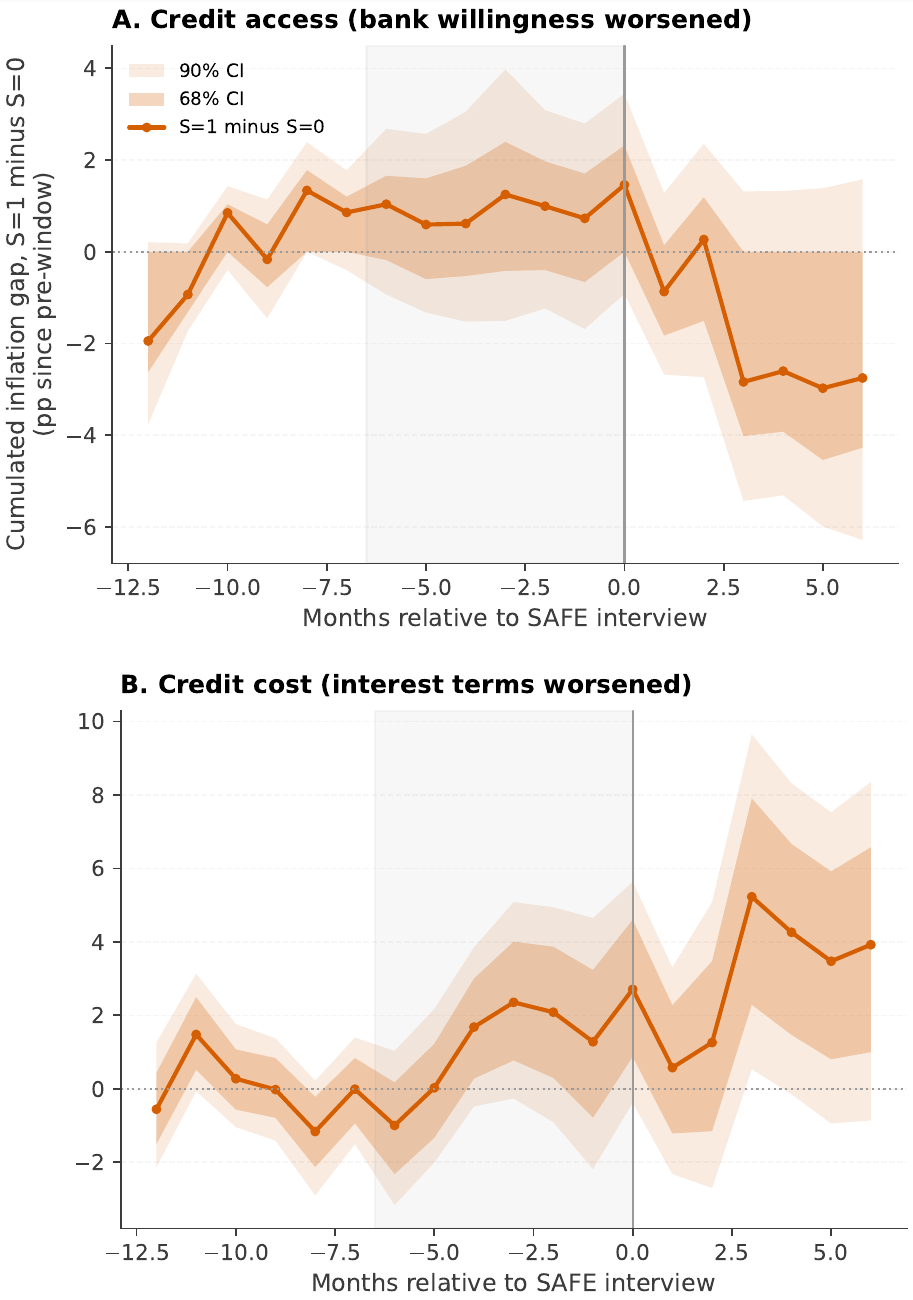
How do financial frictions influence price setting by firms? The literature disagrees even on the sign: constrained firms may raise prices to protect their margins or cut them to raise cash. We link euro-area scanner micro price data to producers' balance sheets and combine this with the answers of the firms in the ECB Survey on the Access to Finance of Enterprises (SAFE). There, we observe both the extensive and intensive margins of credit, and the disagreement in the literature resolves. When banks become less willing to lend, firms raise prices less often and by less to raise cash. When borrowing is more expensive, firms cut prices less often, and inflation rises as they protect their margins. In either case, the firm's response revolves around liquidity, and a menu-cost model with both channels reproduces the responses endogenously. Credit conditions added about 1 percentage point to euro-area grocery inflation in 2021–23, mildly amplifying the surge.